Introduction
The use of animations across our platforms is to create a seamless and enjoyable experience for the fan and enhance it, while helping them to understand the product more effectively. This can include things like transitions, loading indicators, and interactive elements, among others. The goal is to make the user interface more intuitive, engaging, and visually appealing, as well as to provide feedback to the fan about their interactions. All of this is done with the purpose of guiding the fan's attention, communicating changes, and providing visual cues for interacting with the product.
In order to achieve this, we have developed the following principles:
|
GUIDING |
EMOTIVE |
PURPOSEFUL |
|---|---|---|
|
Motion educates the fan by providing context, feedback, and focus. |
We amplify the excitement of the game without focusing on negative emotions or overwhelming the fan. |
Motion knows when and how to approach the fan, prioritising their interest above anything else. |
Motion Language
We have three pillars of our motion language: HUM, SING, and SHOUT.
Duration
The speed of an animation is vital for usability, as it can significantly impact fan experience. Animations that are too fast can be difficult to perceive or disorienting, while those that are too slow can feel intrusive and cause delays. Generally, the duration of animations should fall within the range of 80-440 milliseconds, depending on complexity and the distance the element is traveling. As a rule of thumb, aim for the shortest duration that maintains smoothness without being abrupt. It's more common for animations to be too lengthy than too brief.
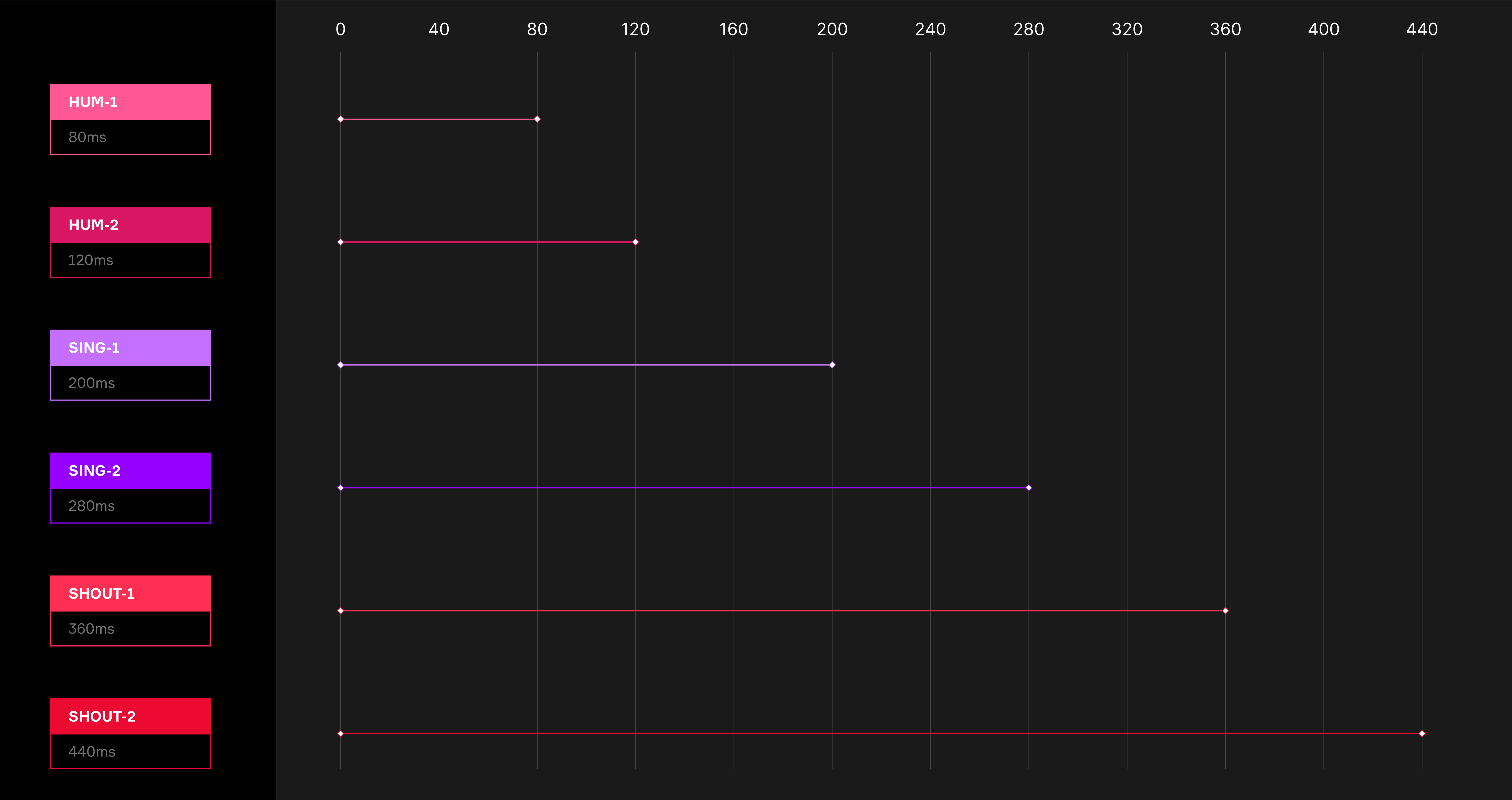
|
Speed |
Animation |
|---|---|
|
80ms |
hum-1 |
|
120ms |
hum-2 |
|
200ms |
sing-1 |
|
280ms |
sing-2 |
|
360ms |
shout-1 |
|
440ms |
shout-2 |
Easing
Easing refers to the rate of change of an animation over time. It controls the speed at which an animation progresses, imparting personality and evoking emotions in the fan.
|
Type |
Curve |
Usage |
|---|---|---|
|
Ease in & Out |
Cubic-Bezier (0.65, 0, 0.14, 1) |
This is used for elements visible from beginning to end. |
|
Ease In |
Cubic-Bezier (0.45, 0.06, 0.6, 0.13) |
This is used for elements that are leaving the screen. |
|
Ease Out |
Cubic-Bezier (0.29, 0.96, 0.56, 1) |
This is used for elements that are appearing into the screen. |
|
Linear |
Cubic-Bezier (0.00, 0.00, 0.00, 0.00) |
This is used for colour transformations or for changing the opacity of the object |
Reduced Motion/Remove Animations
Motion should be used with the intention of solving fan problems and bringing delight without disorienting fans. Excessive motion can not only distract fans but also increase page load times and cause accessibility issues.
Most major operating systems allow people to set their preferences when it comes to motion; this shouldn't be ignored and should be taken into account when providing motion.
If/when motion is turned off or reduced, there should always be a fallback option so we're not degrading the overall experience.
Frequency & Stop Conditions
Motion is most effective when it is temporary, intentional, and self-limiting. Beyond how an animation looks, how often it appears and when it stops is critical to creating a clear and respectful fan experience.
Frequency
Motion used to hint at or teach interactions should be noticeable but not overwhelming.
- Within a session, an animation can repeat a limited number of times to introduce the interaction.
- Across sessions, motion should act as a temporary guide, not a permanent decoration.
- Intervals that are too short may feel distracting; intervals that are too long may lose their purpose as a hint.
Principle: Motion should teach behavior without hijacking attention.
Stop Conditions
Every animation should have a clear exit strategy.
- After interaction: Once a fan interacts with the animated element, motion should stop.
- After repeated non-interaction: If a fan consistently ignores the motion across sessions, it should stop.
- Long-term reminders (optional): After an extended period of inactivity, motion may briefly appear once as a soft reminder.
Principle: Motion is respectful and adaptive, reinforcing learning while avoiding fatigue or distraction.